
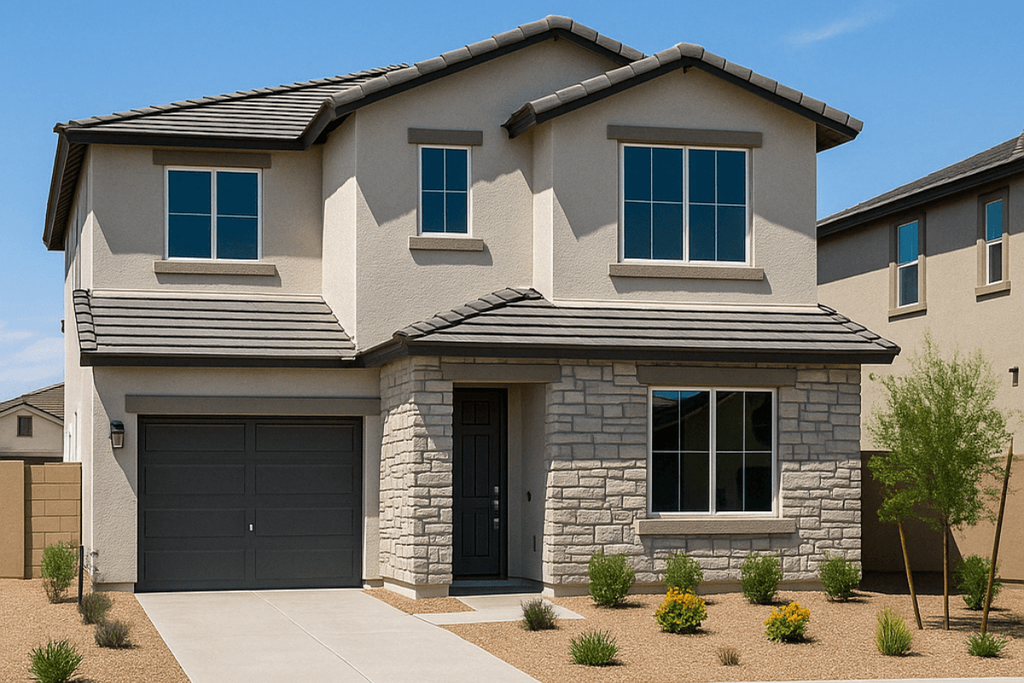
Finding a brand-new home in Glendale for less than $500,000 is still possible in 2026, but the search takes a little more homework than the builder signs make it seem.
Several communities, including Stonehaven, Legacy Place, Bethany Grove, Seasons at Trevino, and Icon at Thunderbird, have offered floor plans or inventory around this price point. The catch is that a home’s advertised starting price and the amount you ultimately spend can be two very different numbers.
Lot premiums, design upgrades, HOA dues, landscaping, financing costs, and even the specific homesite you choose can change the equation quickly.
For buyers comparing Glendale, AZ homes for sale, especially first-time buyers and people relocating to Arizona, the goal shouldn’t simply be to find something with a “$4” at the beginning of the price. It’s to understand what you’re actually buying and what it will really cost to own.
Can you buy a new home in Glendale, AZ for under $500,000 in 2026?
Yes. Several Glendale communities have new-construction floor plans or select quick-move-in homes priced below $500,000. However, buyers need to account for lot premiums, builder options, HOA fees, taxes, insurance, landscaping, and financing. A home advertised at $470,000 can easily cross $500,000 once everything is added.
Where Can You Find New Homes Under $500K in Glendale?
New construction below $500,000 isn’t spread evenly across Glendale. It’s concentrated in several communities and ZIP codes, and availability changes as builders release lots, sell quick-move-in homes, and adjust incentives.
As of fall 2026, buyers looking near or below the $500,000 mark may encounter options such as:
| Community | ZIP Code | Builder | Pricing Position |
| Stonehaven Discovery | 85305 | Taylor Morrison | Starting in the low $440Ks |
| Stonehaven Encore | 85305 | Taylor Morrison | Starting around the upper $470Ks |
| Stonehaven Expedition | 85305 | Taylor Morrison | Select plans starting just below $500K |
| Seasons at Trevino / Trevino II | 85302 | Richmond American | Select plans and inventory in the mid $400Ks |
| Chalet at Legacy Place | 85303 | K. Hovnanian Homes | Starting in the mid $400Ks |
| Icon at Thunderbird | 85306 | Woodside Homes | Smaller plans starting in the upper $460Ks |
| Bethany Grove | 85303 | Beazer Homes | Select plans and quick-move-in homes around the upper $460Ks and above |
Builder pricing and incentives can change quickly, sometimes from one homesite to the next. Think of these numbers as a starting point for your search, not a promise of what a particular home will cost when you sign.
Stonehaven in 85305
Stonehaven is one of the most notable places to look for new construction under $500,000 because Taylor Morrison offers multiple collections within the development.
The Discovery Collection has included some of the lowest starting prices, while Encore and Expedition offer larger plans that can approach or exceed the $500,000 line.
Stonehaven also puts buyers close to Loop 101 and the Westgate area, including State Farm Stadium and the Westgate Entertainment District. That makes it especially worth considering for buyers who value freeway access, entertainment, shopping, or connections to other parts of the West Valley.
The important distinction is that “starting under $500K” does not mean every Stonehaven home is under $500K. Larger floor plans, upgraded lots, quick-move-in packages, and additional options can push the price well above it.
Seasons at Trevino in 85302
Seasons at Trevino and Trevino II offer another type of Glendale new-construction experience.
Rather than feeling like a large master-planned community on the outer edge of the Valley, this area sits within a more established portion of Glendale near the Northern Avenue corridor. That can appeal to buyers who want a new house but don’t necessarily want to move farther away from existing shopping, schools, healthcare, and everyday services.
For some buyers, location will matter more than having the biggest community pool or longest amenity list.
Legacy Place and Bethany Grove in 85303
ZIP code 85303 also deserves attention.
K. Hovnanian’s Chalet at Legacy Place has offered new single-family homes beginning in the mid $400,000s, while Beazer’s Bethany Grove has also had select homes starting below $500,000.
These communities can be particularly interesting to buyers comparing new construction against established west-central Glendale neighborhoods.
Icon at Thunderbird in 85306
Woodside Homes’ Icon at Thunderbird is another option, although buyers trying to remain under $500,000 will generally be looking at the community’s smaller floor plans.
That isn’t necessarily a negative.
A thoughtfully designed 1,400 to 1,700 square foot house can make considerably more financial sense than stretching the budget simply to gain another bedroom or oversized loft you don’t need.
The better question is always, “Does the house work for the way we’ll actually live?”
The Reality of a $500,000 New Construction Budget
Glendale’s overall resale market includes plenty of homes below $500,000. Brand-new construction is a different story.
Recent citywide sale prices have generally been in the low to mid $400,000s, while new homes often command a premium over older resale properties. That means a hard $500,000 ceiling can narrow the new-construction choices considerably.
Buyers at this price point are more likely to find:
- Smaller single-family floor plans
- Three-bedroom homes
- Compact lots
- Homes with fewer structural upgrades
- Select quick-move-in inventory
- Builder inventory receiving promotional pricing
- Attached or paired-home options in some areas
Four-bedroom detached homes under $500,000 can exist, but the choices become thinner once lot premiums and upgrades are added.
That’s one reason it helps to compare the new-home search with nearby resales instead of assuming new construction is automatically the better value.
Why the Advertised Price Rarely Matches What You Pay
Walk into a model home and it’s easy to understand why people fall in love.
The flooring looks great. The kitchen has the oversized island. The lighting is perfect. The patio doors disappear into the wall. Even the backyard seems ready for a magazine shoot.
Then you discover that half of what caught your eye isn’t included in the price on the sign outside.
Builder advertisements usually show a starting price for a particular floor plan. The model home may include thousands of dollars in structural options, finishes, landscaping, appliances, lighting, cabinetry, flooring, and other upgrades. Contact us today.
Common Costs Added to the Base Price
Depending on the builder and homesite, additional expenses can include:
- Lot premiums
- Larger or corner homesites
- Preferred orientation or views
- Additional bedrooms
- Extended covered patios
- Garage upgrades
- Flooring
- Cabinets and countertops
- Appliance packages
- Electrical and lighting upgrades
- Window coverings
- Backyard landscaping
- Fencing or gates
- Design-center selections
A lot premium alone can move a seemingly affordable house much closer to your maximum budget.
If your ceiling is truly $500,000, don’t shop as though $499,000 is your target base price. Leave room.
A buyer who starts with a $465,000 or $475,000 floor plan usually has more flexibility than someone who falls in love with a $499,000 plan before discussing a single option.
Look at the Total Monthly Cost, Not Just the Purchase Price
A $490,000 home isn’t automatically affordable because the mortgage calculator says it is.
The more useful number is your total monthly ownership cost.
That calculation should include:
- Mortgage principal and interest
- Property taxes
- Homeowners insurance
- HOA or community dues
- Utility expectations
- Any applicable special district assessments or other recurring charges
If you’re comparing several Glendale Arizona home communities, use the same calculation for each one. The home with the lowest purchase price isn’t always the one that costs the least each month.
HOA and Community Costs
Many newer Glendale developments have HOAs, especially communities offering parks, pools, trails, landscaping, gates, or other shared amenities.
Don’t treat the HOA payment as background noise.
Ask:
- What are the current dues?
- What does the HOA maintain?
- Have dues increased recently?
- Are there additional community or sub-association fees?
- Are there transfer or setup charges when buying?
- What do the CC&Rs restrict?
- Are there rules affecting parking, RVs, exterior changes, landscaping, rentals, or solar?
Read the actual documents rather than relying on the sales brochure.
A community pool may sound wonderful until you realize you don’t use it and would rather put the monthly difference toward a larger backyard.
For another buyer, that same pool and park may be exactly what makes the neighborhood worthwhile.
Don’t Forget Arizona Utility Costs
A new home’s energy efficiency can be one of its strongest advantages in Glendale, but buyers still need to understand what they’re getting.
A house can feel wonderfully comfortable during a February model-home tour. July is the better test.
Ask the builder about:
- HVAC efficiency and equipment
- Insulation
- Window specifications
- Attic insulation
- Air sealing
- Orientation of the home
- Solar options or solar-ready features
- Which electric utility serves the property
A west-facing wall full of windows and a shaded north-facing patio create different experiences during a Phoenix summer.
If the home includes solar or the builder offers it as an option, evaluate the economics carefully. Confirm who owns the system, what it costs, how it affects financing, and what utility rate structure applies to the address.
Glendale Neighborhood Location Matters More Than the City Name
One of the biggest mistakes buyers make is searching “Glendale” as though every part of the city offers the same lifestyle.
It doesn’t.
Glendale stretches across a large portion of the West Valley, and two homes with Glendale addresses can provide completely different commutes, schools, surroundings, housing stock, and access to amenities.
Westgate and 85305
The 85305 area puts buyers near some of Glendale’s best-known destinations, including Westgate Entertainment District and State Farm Stadium.
Loop 101 also provides useful access north toward Peoria and the Northwest Valley and south toward I-10.
For some buyers, being near major sporting events and entertainment is a plus. Others may prefer to be farther removed from event traffic and activity.
That’s why it’s worth visiting a neighborhood at different times, not just during the builder’s Saturday afternoon open house.
Central and West-Central Glendale
Communities in 85302 and 85303 can provide easier access to established portions of Glendale, existing shopping corridors, healthcare, schools, and older residential neighborhoods.
A newer house in an established area can offer a different lifestyle from a large master-planned development farther west.
Neither is automatically better. They simply solve different problems.
Thunderbird and North Glendale
Areas around 85306 and the Thunderbird corridor provide access to established retail, medical services, employment areas, and north Glendale neighborhoods.
Buyers searching here should compare the specific homesite with nearby roadways, commercial uses, schools, and aviation considerations rather than judging the location solely from an online map.
School Boundaries Need to Be Checked by Address
“Glendale schools” isn’t a useful enough answer when you’re buying a house.
The city crosses multiple school district boundaries. Depending on the location, properties may fall within districts such as Deer Valley Unified, Peoria Unified, Glendale Elementary, Glendale Union High School District, or other nearby districts.
If school assignment matters to your purchase, verify the exact property address.
Don’t assume two communities a few miles apart share the same schools, and don’t rely exclusively on a community brochure. Boundaries and assignments can change as areas grow.
The practical approach is simple:
- Identify the exact homesite or address.
- Verify the assigned schools directly with the applicable district.
- Review the information that’s important to your household.
- Visit the area at the times you’ll actually be using it.
A five-minute drive on Sunday afternoon tells you very little about what school traffic or a weekday commute feels like.
Buying in West Glendale? Understand Luke Air Force Base

This is exactly the kind of issue an out-of-state buyer may never think to ask about.
Luke Air Force Base is a major part of the West Valley, and aircraft activity can affect some properties in western Glendale and surrounding communities.
That doesn’t mean you shouldn’t buy there. Plenty of people happily live in areas affected by military flight activity.
It does mean you should know what you’re purchasing before you commit.
For properties farther west, consider:
- Reviewing applicable Luke AFB noise and land-use maps
- Checking whether the property falls within an airport-related overlay or influence area
- Reviewing any aviation or avigation disclosures in the contract
- Visiting the homesite on a weekday when flight activity may be occurring
- Asking questions about aircraft noise before your inspection period expires
You can’t accurately judge aircraft noise from listing photos.
That sounds obvious, but buyers relocating from another state sometimes tour on a quiet weekend, buy remotely, and only discover the everyday experience afterward.
New Construction vs. Resale Under $500K
This is one comparison more Glendale buyers should make.
There is significantly more resale inventory below $500,000 than brand-new detached-home inventory. Buyers who become too focused on the word “new” can overlook homes nearby that may offer substantially more for the money.
| New Construction | Resale Home |
| Newer HVAC, roof, plumbing, and electrical systems | Potentially larger lot |
| Modern energy standards | Mature landscaping and shade trees |
| Builder warranty coverage | Pool may already be installed |
| Contemporary layouts | More established neighborhood |
| Lower immediate maintenance in many cases | More location choices |
| Ability to choose some finishes | Existing improvements are already included |
| Possible builder financing incentives | Greater opportunity to evaluate an established property’s history |
A resale home might need an HVAC system sooner. A new home might need $30,000 in backyard, window, and design work after closing.
This is why purchase price alone isn’t enough.
We’ve seen this logic play out again and again in real estate searches: buyers walk into a model home convinced they want new construction, then realize a 10 or 15-year-old home nearby already has the pool, mature landscaping, window coverings, ceiling fans, and larger lot they were planning to add later.
Run both numbers.
Builder Incentives Can Be Valuable, but Compare the Whole Loan
Builders have continued using incentives in the current market to attract buyers and move inventory.
Depending on the builder, community, home, and timing, offers may include:
- Closing-cost assistance
- Temporary rate buydowns
- Permanent rate incentives
- Design-center credits
- Reduced pricing on quick-move-in homes
- Appliance or upgrade packages
Some incentives are tied to using a builder-affiliated or preferred lender and title provider.
That’s not automatically a bad deal. In fact, builder financing can sometimes be extremely competitive.
The mistake is assuming the incentive makes it the best deal without comparing it.
Ask for the full loan estimate and compare:
- Interest rate
- APR
- Discount points
- Origination charges
- Lender fees
- Closing credits
- Cash required at closing
- Monthly payment
- Cost over the period you realistically expect to own the home
A flashy “$20,000 incentive” doesn’t tell you whether you’re getting the best financing.
The math does.
Quick-Move-In Home or To-Be-Built Home?
Buyers shopping new construction generally encounter two types of opportunities.
Quick-Move-In Homes
These homes are already under construction or completed.
Advantages can include:
- Faster closing
- Known homesite
- Known finish package
- Less construction uncertainty
- Potential builder discounts on inventory the builder wants sold
The downside is that many design decisions have already been made for you.
To-Be-Built Homes
Starting earlier in the construction process may give you more choice over the homesite, floor plan, structural options, and finishes.
You’ll also wait longer.
Build schedules can change due to permitting, inspections, materials, labor, or other construction issues. Don’t plan the sale of your existing home, lease expiration, or moving truck around an estimated completion date without some flexibility.
Should You Time Your Purchase Around Builder Incentives?
Timing can matter, although there is no magical “best day” to buy a new home.
Builders manage inventory, sales goals, completed homes, lot releases, and financing promotions. Incentives can sometimes become more attractive when a builder has homes it wants off the books or needs to generate sales activity.
That might happen near a month-end, quarter-end, phase closeout, or when a particular quick-move-in home has been sitting.
But waiting solely for a theoretical better deal can backfire if the homesite or floor plan you actually want disappears.
The goal isn’t to perfectly time the builder.
It’s to know what inventory exists, understand which homes have negotiating room, and recognize when an incentive actually improves your deal.
Bring Your Own Real Estate Agent Before You Start Touring
The friendly person sitting inside the model home represents the builder’s interests in the transaction.
That’s normal. It’s their job.
Your real estate agent has a different role: helping you evaluate the purchase from your side of the table.
Builder policies for outside agents vary. Many require a buyer’s agent to be identified or registered at the buyer’s initial visit or early in the process.
If you’re already working with an agent, don’t casually walk into half a dozen communities assuming you can add them later.
Before visiting:
- Tell your agent which communities you want to see.
- Ask about that builder’s current registration policy.
- Have the agent accompany you or properly register according to the builder’s requirements.
- Don’t sign paperwork you don’t understand simply because you’re “only looking.”
The onsite sales team can tell you about the builder’s homes.
Your own representation should help you decide whether one of those homes is actually right for you.
What a Buyer’s Agent Should Help You Evaluate
Good new-construction representation goes far beyond getting you through the sales office door.
A local agent can help you compare:
- Base price versus actual price
- Homesite premiums
- Builder inventory
- Quick-move-in opportunities
- Financing incentives
- Resale alternatives
- Neighborhood location
- HOA structure
- School boundaries
- Contract deadlines
- Inspection opportunities
- Future nearby construction
- Property orientation
- Resale implications
This is particularly valuable for someone relocating to Arizona.
A builder can show you its best available home.
A buyer’s agent should be willing to tell you that the resale two miles away, or another builder altogether, makes more sense.
New Homes Still Need Independent Inspections
Brand-new does not mean flawless.
A municipal inspection verifies compliance with applicable construction requirements. It is not the same thing as hiring an independent home inspector to evaluate the property for you.
Depending on the stage of construction and your contract, buyers may consider inspections such as:
Pre-Drywall Inspection
If your timing and builder allow it, an inspector can examine components before the walls are closed.
That may include accessible framing, plumbing, electrical work, ductwork, roof components, and other visible construction details.
Pre-Closing Inspection
An independent inspection before closing can identify items that need further evaluation or correction.
In Arizona, areas worth paying particular attention to can include:
- HVAC installation and performance
- Roof and flashing
- Stucco
- Grading and drainage
- Plumbing
- Electrical systems
- Windows and doors
- Insulation where visible
- Appliances
- Irrigation
- Pool equipment, if applicable
Final Walkthrough
The builder will usually conduct its own orientation or walkthrough.
Use it.
Test doors, faucets, outlets, windows, cabinets, appliances, lights, and other finishes. Photograph outstanding items and understand the builder’s process for completing the punch list.
Fresh paint can hide a surprisingly long list of little things.
Arizona-Specific Details to Look at Before Choosing a Homesite
Two identical floor plans can live very differently because of where they’re placed.
Before paying a lot premium, consider:
Sun Exposure
Which direction does the backyard face?
Where will the afternoon sun hit?
Will your patio receive shade when you actually want to use it?
In Glendale, orientation is more than a cosmetic preference.
Drainage and Grading
Phoenix is dry most of the year, but monsoon storms can deliver a lot of water quickly.
Look at how water is designed to move around the lot and nearby common areas.
Future Construction
That beautiful open view may be open only because the next phase hasn’t been built yet.
Ask what is planned behind, beside, and across from the property.
Traffic and Community Amenities
Living beside the community park may sound great until you realize the basketball court lights are outside your bedroom.
Likewise, being near the entrance can be convenient, but it may bring additional vehicle traffic.
There is no perfect lot. There is only the lot whose tradeoffs make the most sense to you.
What Does the 2026 Glendale Market Mean for New-Home Buyers?
Glendale is no longer operating like the frantic market buyers experienced several years ago.
Homes citywide have recently been taking roughly two months to sell in many cases, although conditions vary considerably by ZIP code, price range, property type, and neighborhood.
That’s useful for buyers.
Builders may have more reason to compete through pricing, financing incentives, concessions, or quick-move-in discounts than they did when buyers were lining up for lot releases.
Still, good properties at attractive prices can sell.
A balanced strategy makes more sense than either extreme. Don’t panic and overpay, but don’t assume every builder will eventually discount the exact home you want.
A Practical Checklist Before You Put Money Down
Before signing a builder contract for a Glendale new home under $500,000, make sure you know:
- The true purchase price. Include the lot, structural options, design selections, and required packages.
- Your estimated cash to close. Don’t confuse purchase price with the amount of money you’ll need before move-in.
- Your actual monthly payment. Include taxes, insurance, HOA dues, and realistic utility expectations.
- What is included. Ask specifically about appliances, window coverings, landscaping, fencing, lighting, and smart-home equipment.
- What isn’t included. This is often the more revealing question.
- The HOA rules and costs. Read the documents.
- The assigned schools. Verify by the specific address if schools matter to your decision.
- The surrounding land uses. Check planned development, roads, commercial projects, and Luke AFB considerations where relevant.
- The inspection rights. Understand exactly what your contract allows.
- The financing comparison. Price the builder’s offer against at least one reasonable alternative.
- The resale competition. See what the same budget buys within a few miles.
- The builder warranty. Understand what is covered, for how long, and how warranty claims are handled.
Buying New Construction in Glendale Doesn’t Have to Be Complicated
There are real opportunities to buy a new home in Glendale for less than $500,000 in 2026.
The challenge isn’t simply finding one.
It’s determining which advertised price is realistic, which community fits your day-to-day life, which builder incentive actually saves money, and whether new construction still wins once you compare the total cost with nearby resale homes.
That’s where experienced representation becomes valuable.
Lockwood Real Estate Group can help you evaluate Glendale homes for sale, compare builders and resale properties, understand neighborhood differences, and look beyond the model-home presentation before you commit.
If you’re considering new construction in Glendale, reach out before your first builder visit. We’ll help you understand the options and make sure you’re comparing the things that actually matter.
You can also read our guide to choosing a trustworthy real estate team in Phoenix if you’re still deciding who should represent you.
Frequently Asked Questions About New Homes in Glendale Under $500K
There is no reliable percentage that applies to every builder or buyer. A conservative approach is to leave meaningful room below your absolute budget ceiling because lot premiums, structural selections, design upgrades, landscaping, window coverings, and other expenses can add thousands of dollars. Ask for an itemized estimate before assuming a floor plan fits your budget.
Many new-construction homes can be purchased using FHA or VA financing if the borrower, property, loan, and transaction meet the applicable program requirements. Eligibility can depend on the property type and circumstances, so buyers should confirm financing with their lender rather than assuming every community or home qualifies automatically.
Yes, builders commonly work with buyers who have their own real estate agents. Registration requirements vary by builder, and some require the agent to accompany or register the buyer from the first visit. If you want your own representation, involve your agent before touring rather than trying to add them after you’ve begun negotiating.
An independent inspection is a smart consideration even with new construction. New homes can still have issues involving HVAC installation, roofing, stucco, drainage, electrical work, plumbing, windows, or finish quality. Depending on construction stage and contract terms, buyers may also be able to arrange a pre-drywall inspection.
It depends on the property’s location and your sensitivity to aircraft activity. Buyers considering western Glendale should review applicable airport influence or noise information for the specific parcel, read aviation-related disclosures carefully, and visit the property during normal weekday activity before committing.
Not automatically. New construction may offer modern layouts, newer systems, energy efficiency, and builder warranty coverage. Resale homes can offer larger lots, established landscaping, existing pools, mature neighborhoods, and more central locations for the same budget. Compare total cost and lifestyle rather than simply comparing the age of the house.
They can be. Builder closing-cost credits and mortgage-rate incentives may create substantial savings, particularly on quick-move-in inventory. Buyers should still compare the preferred lender’s APR, fees, points, cash to close, and monthly payment with outside financing before deciding which offer is actually better.
A completed or nearly completed quick-move-in home may close relatively quickly once financing and inspections are complete. A home built from an earlier stage can take several months. Construction schedules are estimates, so buyers coordinating a lease expiration or sale of another home should leave room for delays.
Not always, but builders sometimes discount completed or aging inventory to encourage a faster sale. A quick-move-in home can be an excellent value when the builder wants it sold, although you usually have less control over finishes and structural selections.
If you plan to have buyer representation, it’s better to involve your agent first. Builder registration policies differ, and walking in alone can complicate representation later. A short call or text before visiting can prevent an unnecessary problem.
One change I especially like here is that the article now answers the question behind the keyword, not merely “where are homes under $500K?” but “can I actually buy one for under $500K once everything is considered?” That makes it much more useful for both organic search and AI-generated answers.